SiriusOne:
Comprehensive UX Audit and Optimization for Intelligent Trip Tracking Platform
Improving onboarding trust, reducing trip classification friction, and accelerating report generation through structured UX transformation.Client & Project Overview
A mobility technology company developing an intelligent trip-tracking platform approached SiriusOne to improve the user experience of its mileage classification application.
The product already had strong technical capabilities for automatic trip capture. However, early product analytics and user feedback revealed critical friction points during onboarding, trip classification, and report generation.
Users struggled to understand system status, required excessive manual effort to classify trips, and often lost time preparing reports.
The objective of the engagement was to transform research insights into a structured UX improvement roadmap that would increase user confidence, accelerate daily workflows, and improve overall platform adoption.
Key goals included:
- increasing trust during first-time setup
- reducing friction in trip classification
- improving reporting reliability
- preventing common user errors
- aligning the product with modern UX standards seen in competing platforms
Business Problem
Low Trust During Initial Setup — Users were unsure whether tracking was functioning correctly. Permission requests appeared technical and legalistic, without explaining why the data was required. This uncertainty slowed onboarding and reduced early engagement.
Trip Management Was Not the Primary Interface — The home screen focused primarily on calendar navigation. However, users typically wanted to see their most recent trips immediately and take quick actions. This caused friction when trying to classify trips efficiently.
Limited Visibility Into Progress — Users could not easily see daily mileage totals, estimated reimbursements, classification progress, or report readiness. Without visible feedback, the product's value remained hidden until the reporting stage.
Risk of User Errors — Duplicate trips occasionally appeared during imports. Account deletion lacked safeguards. Primary actions were not always visually prioritised. These issues reduced user confidence in the platform.
Reporting Workflow Friction — Preparing reports required too many manual steps. Users expected faster export flows, expense capture, flexible reporting formats, and better tracking visibility.
Tech Stack
Evaluation Framework: Nielsen's 10 Usability Heuristics
Research Methods: Heuristic Evaluation · Competitor Analysis · Benchmark Analysis
Deliverables: UX Audit Report · Improvement Roadmap · Benchmarking Matrix · Competitive Analysis
Target Platform: Mobile application (iOS · Android)
#UXAudit
#ProductDesign
#MobilityTech
#UXResearch
Project Timeline

The audit delivered a structured set of outputs, not only an improvement roadmap. Key deliverables included:
- Overview of the project, core problems, and recommendations
- Structural UX architecture and content review
- Detailed list of usability issues with remediation recommendations and expected impact on key metrics
- Priority map separating quick wins from strategic long-term improvements
- Consolidated synthesis of research and competitive benchmarking
- Heuristic evaluation scorecard based on Nielsen's 10 principles
- Benchmarking matrix
- Competitor analysis presentation
The improvement roadmap was structured into three development horizons:
Duration
12+ weeks
Effort
3-phase roadmap
Phase 1 — Immediate Improvements
0–6 weeks
Simplified permission explanations, onboarding progress indicators, chronological trip timeline, swipe-based classification, inline editing, multi-select with undo, post-trip value summaries
Phase 2 — Structural UX Improvements
6–12 weeks
Redesigned navigation structure, centralised system status visibility, reporting preview dashboards, duplicate detection, account deletion safeguards, automated classification rules
Phase 3 — Advanced Product Capabilities
12+ weeks
Expense tracking hub, receipt capture with OCR, fuel and maintenance tracking, Bluetooth trigger-based tracking, scheduled reporting, advanced classification rules
Team involved

Lead UX Designer

Product Strategy Consultant

Mobile UX Specialist

Data Analytics Specialist
Solution Overview
Trust From the First Interaction
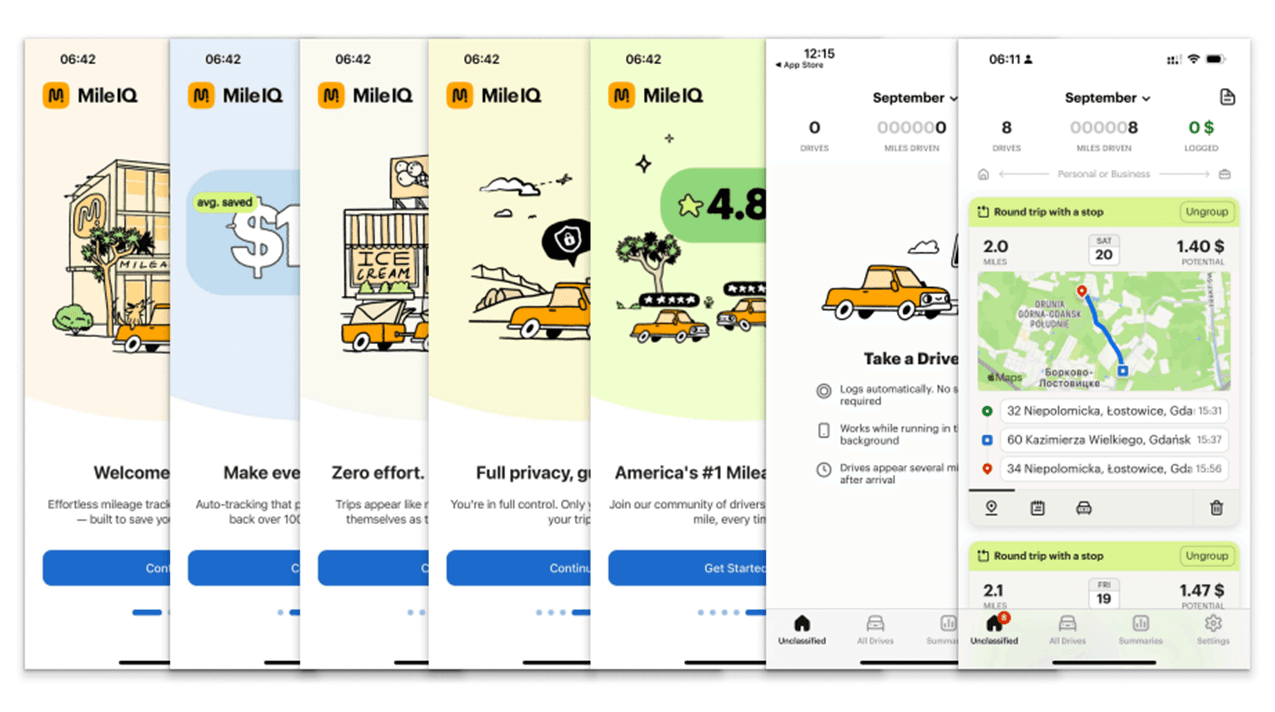
The audit revealed that permission screens were a primary drop-off point during onboarding. Users encountered technical, legalistic language without context for why location data was needed. The recommended solution redesigned permission requests to clearly explain the purpose and benefit of each data type. A live system status widget was introduced to provide continuous feedback on tracking health, GPS or Bluetooth status, and synchronization state.
Trips as the Central Product Object
Heuristic evaluation identified that the calendar-first home screen created cognitive friction. The audit recommended redesigning the interface around a rich chronological trip timeline. Each trip card displays route map, start time, distance, classification status, vehicle and purpose, and synchronization state — enabling fast classification decisions without multi-screen navigation.
Visible Progress and Value
Benchmarking against competing platforms revealed that leading products surface key metrics directly on the home screen. The solution surfaces daily and monthly summaries, estimated reimbursements, classification progress, and report readiness directly on the home screen.
Error Prevention and Recovery
The audit identified duplicate trip imports and unprotected account deletion as significant trust risks. Recommended solutions include automated duplicate detection, re-authentication requirements before critical actions, a recovery window after deletion, and visual prioritization of primary actions throughout the interface.
Results
Activation
Faster onboarding and shorter time to first valid trip classification.
Engagement
Reduced time required to classify trips and lower backlog of unclassified trips.
Reporting Efficiency
Higher share of reports generated successfully on the first attempt.
Trust and Reliability
Lower duplicate trip creation rate and fewer support requests related to tracking status.

Similar
implemented cases:
AI-Powered Customer Support Automation
AI-Powered Quality Control for Banking Operations
Enterprise Azure Data Warehouse Modernization
AI-Powered Credit Risk Analytics & Vintage Analysis Platform with Chatbot Interface
AI-Powered Credit Risk Analytics Platform
Comprehensive UX Audit and Optimization for Intelligent Trip Tracking Platform
Turning Competitor Ads into AI-Powered Market Intelligence
AI-Powered Loan Application Automation


AI Bot for Customer Support in Retail
AI-Powered OCR Automation for Financial Document Processing


AI-Powered Image Redaction for Privacy Protection in Aerial Imagery


AI Bot for a Governmental Organization
AI Bot for HR & Recruitment Departments


Machine Learning Model for Optimal and Cost-Effective Predictions
Machine Learning-Enhanced Travel Booking Platform


AI-Powered Real Estate Valuation Platform


AI-Driven Anti-Money Laundering (AML) System