SiriusOne:
AI-Powered Quality Control for Banking Operations
Computer-vision compliance monitoring across 29 branches — replacing manual audits with continuous, real-time behaviour and service-standard analysis.Client & Project Overview
A regional bank operating 29 branches was running quality control the traditional way — periodic manual and remote audits, mystery shopper visits, and supervisor walkthroughs. Coverage was inconsistent. The compliance team was spending more time collecting data than acting on it.
The bank had detailed service standards: dress code policies, service scripts, and customer interaction protocols. But with 29 branches and hundreds of daily customer interactions, enforcing those standards manually at scale was operationally impossible.
SiriusOne designed and deployed an AI-powered quality control system that connects to existing branch infrastructure, analyses staff behaviour and service compliance, and delivers structured alerts and reports directly to branch managers and regional supervisors — turning a reactive audit process into a continuous, automated compliance operation.
Business Problem
Manual quality control at branch level creates three structural problems that compound over time.
Coverage is partial by design. A human auditor visiting a branch or remotely connecting to an agent sees a snapshot — one hour, one day, one interaction. The 99% of interactions that happen between audits are invisible to the compliance function.
Response is always retrospective. By the time a quality issue reaches a manager through a manual process — observation, documentation, escalation, review — the interaction has long passed. Coaching happens weeks after the fact. Patterns repeat.
Standards erode gradually. Without continuous monitoring, compliance gaps widen slowly and silently. Dress code deviations become normalised. Service protocols shorten. None of this surfaces in a monthly audit until it becomes a significant issue.
The bank needed a system that monitored every branch, every shift, every interaction — automatically — and delivered actionable intelligence to managers in time to actually do something about it.
We went from monthly audit reports to real-time visibility across every branch. Issues that used to take weeks to surface are now flagged within minutes.
Head of Quality Control Department
Regional Bank
Tech Stack
Computer Vision: OpenCV · PyTorch · TensorFlow · ONNX Runtime
AI/ML: Python · PyTorch · TensorFlow · scikit-learn · NumPy · Pandas · MLflow
Video Infrastructure: RTSP · IP camera / CCTV integration · ONVIF
Backend: Python · FastAPI · PostgreSQL · Redis · REST API · WebSocket / SSE
Cloud: AWS · S3 · Lambda · API Gateway · CloudWatch · EKS
Frontend: React · TypeScript · WebSocket / SSE · Recharts
Deployment & DevOps: Docker · GitHub Actions · container-based CI/CD
Security: On-premise video processing · encrypted data transmission · RBAC · audit logging · GDPR-aligned data retention
#ComputerVision
#ArtificialIntelligence
#MachineLearning
#BankingTechnology
#QualityControl
Project Timeline

Duration
18 weeks
Effort
~2,400 hours (phased engagement across specialists)
Discovery & Business Analysis
2 weeks
Branch audit process mapping, compliance framework review, camera infrastructure assessment, data privacy and legal review
Data Collection & Model Training
3 weeks
Video data collection across pilot branches, annotation, behaviour classification model development, dress code and workspace detection training
Infrastructure & Integration
3 weeks
Edge node deployment, RTSP stream integration, AWS pipeline setup, real-time event processing architecture
Dashboard & Alert System Development
4 weeks
Manager dashboard build, alert logic configuration, compliance scoring engine, report generation, role-based access setup
Pilot Testing & Optimisation
4 weeks
Live deployment across 3 pilot branches, model accuracy tuning, false positive reduction, manager UAT, alert threshold calibration
Full Network Rollout & Training
2 weeks
Deployment across all 29 branches, staff briefing, manager onboarding, documentation, monitoring setup
Team involved


AI/ML Engineers
Developed and trained computer vision models for behaviour classification, dress code detection, workspace compliance, and customer interaction analysis.


Backend Engineers
Built real-time video processing pipeline, event detection system, alert engine, and API layer connecting camera infrastructure to the dashboard.

Cloud Architect
Designed AWS infrastructure, edge processing architecture, and secure data transmission pipeline.

Frontend Engineer
Built branch manager dashboard — real-time alert feed, compliance scoring, branch comparison analytics, and historical reporting.

Project Manager
Coordinated phased rollout, pilot validation, compliance sign-off, and full network deployment across all branches.

Compliance & Legal Specialist
Ensured full alignment with data privacy regulations, video retention policies, staff notification requirements, and audit trail standards throughout delivery.
Solution Overview
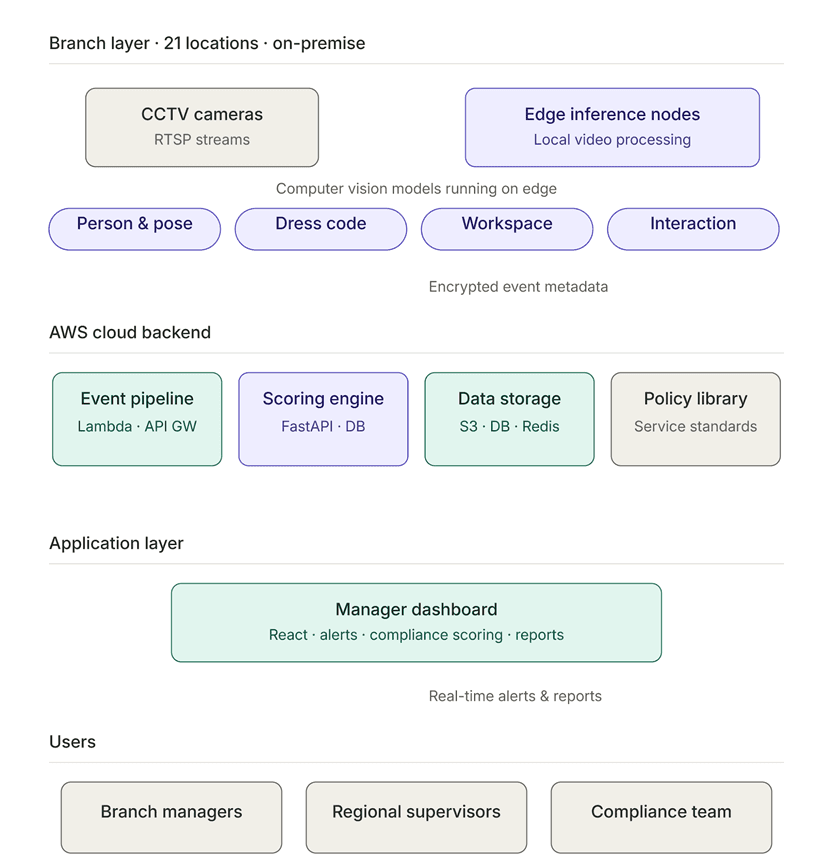
SiriusOne designed and deployed a multi-layer AI quality control system that connects to the bank's existing CCTV infrastructure and operates continuously across all 29 branches — monitoring staff behaviour, service compliance, and workspace standards in real time.
Key features of the solution include:
Video Analysis
The system processes live RTSP streams from existing branch cameras using custom computer vision models. No camera replacement required — the AI layer connects to infrastructure already in place. Edge processing nodes handle video analysis locally, transmitting only structured event data to the cloud — minimising bandwidth and ensuring data privacy compliance.
Automated Compliance Checklists
The system monitors against a configurable digital checklist built from the bank's own service standards — dress code compliance, greeting protocol adherence, workspace organisation, queue management procedures, and customer interaction duration. Each parameter is tracked continuously across every branch and every shift.
Behaviour & Interaction Analysis
Computer vision models detect and classify staff behaviour patterns — identifying protocol deviations, non-standard customer interactions, and service quality signals. The system analyses posture, positioning, engagement indicators, and interaction flow against defined service standards.
Real-Time Alert System
When a compliance deviation is detected, a structured alert is generated and delivered to the relevant branch manager's dashboard within minutes — not weeks. Alerts include timestamp, branch, camera reference, detected issue category, and severity level. Managers receive actionable intelligence, not raw footage.
Branch Manager Dashboard
A centralised web dashboard gives branch managers and regional supervisors real-time visibility across their network. Live compliance scores per branch, alert feed with full history, shift-level performance breakdown, trend analytics, and exportable reports for regional review meetings — all in one place.
Policy & Protocol Integration
The system connects to the bank's internal document library — service manuals, compliance protocols, HR policies, and training materials. Alert recommendations reference the specific policy section relevant to the detected deviation, giving managers a direct link between observation and corrective action.
Results
94% Compliance Monitoring Coverage
Manual audits covered an estimated 3–5% of branch interactions. The AI system monitors 94% of branch hours across all 29 locations — delivering consistent, objective coverage that manual processes cannot match.
67% Reduction in Incident Response Time
Issues that previously surfaced through monthly audit cycles are now flagged to branch managers within minutes of detection. Average response time to compliance incidents dropped from 18 days to under 6 hours.
Improved Service Standard Consistency
Compliance scores across the branch network improved by 41% within the first quarter of full deployment — driven by continuous monitoring creating consistent behavioural standards rather than audit-period spikes.
Operational Efficiency for the Compliance Team
The compliance team eliminated manual audit scheduling, observation logging, and report compilation — redirecting that capacity toward training programme development and policy improvement based on the system's analytical output.

Similar
implemented cases:
AI-Powered Customer Support Automation
AI-Powered Quality Control for Banking Operations
Enterprise Azure Data Warehouse Modernization
AI-Powered Credit Risk Analytics & Vintage Analysis Platform with Chatbot Interface
AI-Powered Credit Risk Analytics Platform
Comprehensive UX Audit and Optimization for Intelligent Trip Tracking Platform
Turning Competitor Ads into AI-Powered Market Intelligence
AI-Powered Loan Application Automation

AI Bot for Customer Support in Retail
AI-Powered OCR Automation for Financial Document Processing


AI-Powered Image Redaction for Privacy Protection in Aerial Imagery


AI Bot for a Governmental Organization


AI Bot for HR & Recruitment Departments


Machine Learning Model for Optimal and Cost-Effective Predictions


Machine Learning-Enhanced Travel Booking Platform


AI-Powered Real Estate Valuation Platform


AI-Driven Anti-Money Laundering (AML) System