Untangling Retail Integrations
Recovering six years of system knowledge, rebuilding integrations and progressively migrating live traffic
- Retail
- AI-Powered Modernisation
- Knowledge Recovery
- Integration Engineering
- Agent-Assisted Engineering
- Progressive Migration
- Observability
Client: Retailer from Saudi Arabia

Project description
A large retailer in Saudi Arabia had lost key knowledge of six years of integration code and databases. Over six months, we used AI to reconstruct it, planned the modernisation, built a standardised platform with engineering agents and progressively migrated live traffic to it.
- Industry:
- Retail
- Solutions:
- Unified integration platform
- Region:
- Saudi Arabia
- Service:
- AI-Powered Modernisation
- Duration:
- 6 months
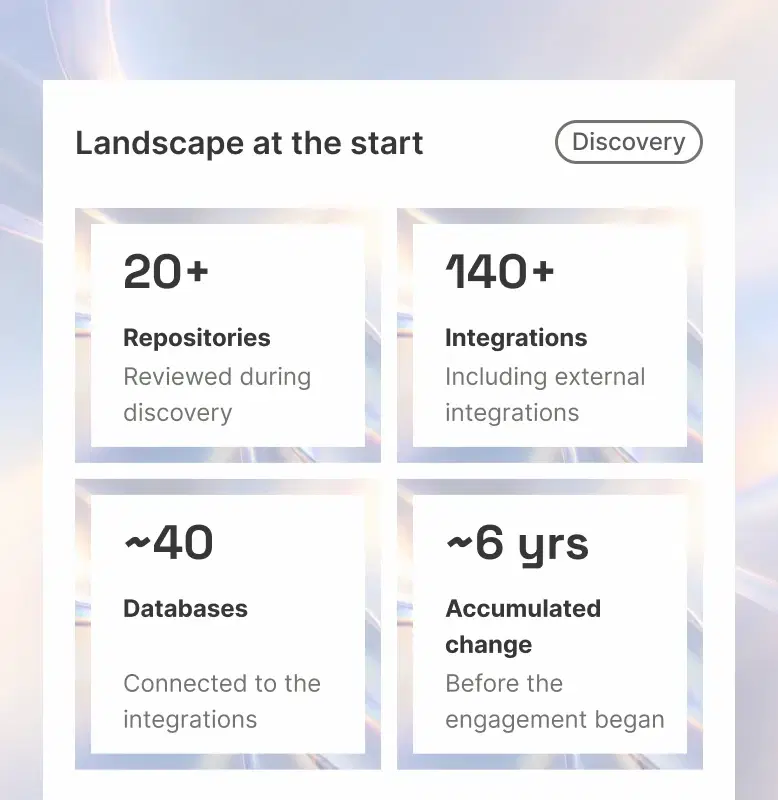
Landscape at the start of the engagement
- 20+
- Repositories Reviewed during discovery
- 140+
- Integrations Including external integrations
- ~40
- Databases Connected to the integrations
- ~6 yrs
- Accumulated change Before the engagement began
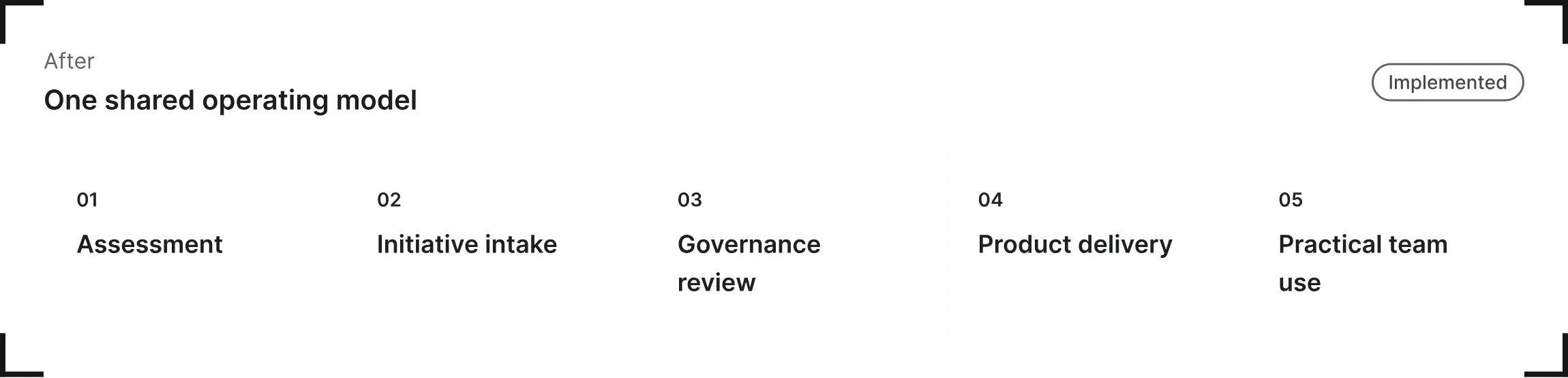
01
Recover knowledge
02
Establish a shared architecture
03
Plan the modernisation
04
Implement with agents
05
Run both platforms in parallel
06
Migrate traffic with AI-assisted monitoring
Delivery sequence, from knowledge recovery to progressive traffic migration.
Challenge
Six years of change had outpaced the documentation.
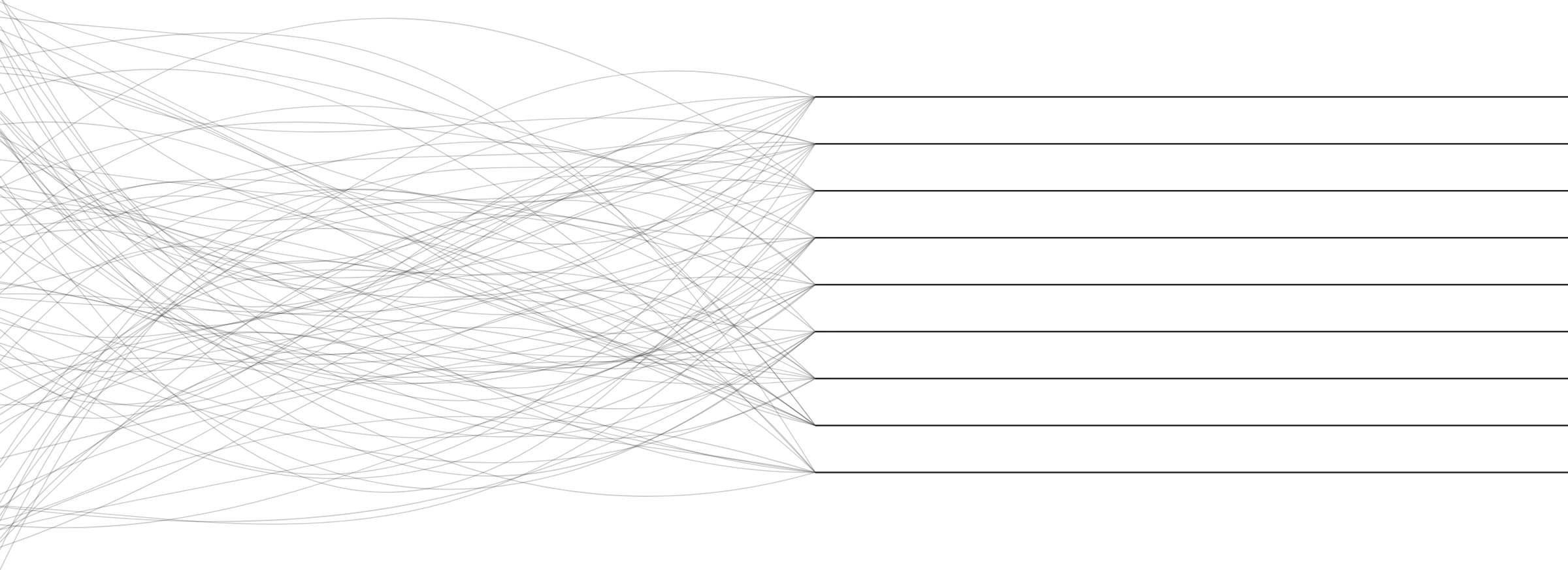
- 01Integration logic was spread across 20+ repositories, 140+ integrations and ~40 databases, with dependencies that required investigation.
- 02Legacy middleware, ETL jobs and custom code followed different practices, with inconsistent testing, deployment and monitoring.
- 03Six years of change had left documentation incomplete and knowledge of integration behaviour reliant on a few specialists.
Architecture, before and after
- Before
- Business applications · Warehouse systems · Store and POS systems · External systems legacy middleware · ETL jobs · custom integration code · point-to-point links · mixed languages 20+ repositories · 140+ integrations · ~40 databases
- After
- Business applications · Warehouse systems · Store and POS systems · External systems Unified integration platform hosted on AWS: Standardised patterns · Release controls Reconstructed system documentation · Documented interfaces and dependency mapping · Centralised operational visibility
- Engineering tooling
- AWS Transform — code transformation Claude via Amazon Bedrock — analysis, documentation, refactoring, tests Engineering agents — implementation ↑ Supported the migration workflow. Not in the production transaction path.
Figure 1. Conceptual architecture.
Transition
Both platforms ran in parallel while live traffic moved across.
We deployed the new platform alongside the existing solution and transferred live traffic in stages. Both platforms reported into centralised monitoring, and AI-assisted analysis of operational behaviour supported the engineers overseeing each stage of the migration.
Parallel operation and progressive traffic migration
- Business, warehouse, store and external systems
- Served by both platforms during the transition
- Existing solution
- Legacy middleware, ETL jobs and custom code
- New integration platform on AWS
- Standardised framework and documented interfaces
- Progressive traffic migration
- From the existing solution to the new integration platform
- Centralised monitoring
- Shared health, failures and dependencies across both platforms
- AI-assisted operational analysis
- Analysis of operational behaviour during migration
- Engineering oversight
- Engineers decided when each stage of traffic moved
Landscape at the start of the engagement 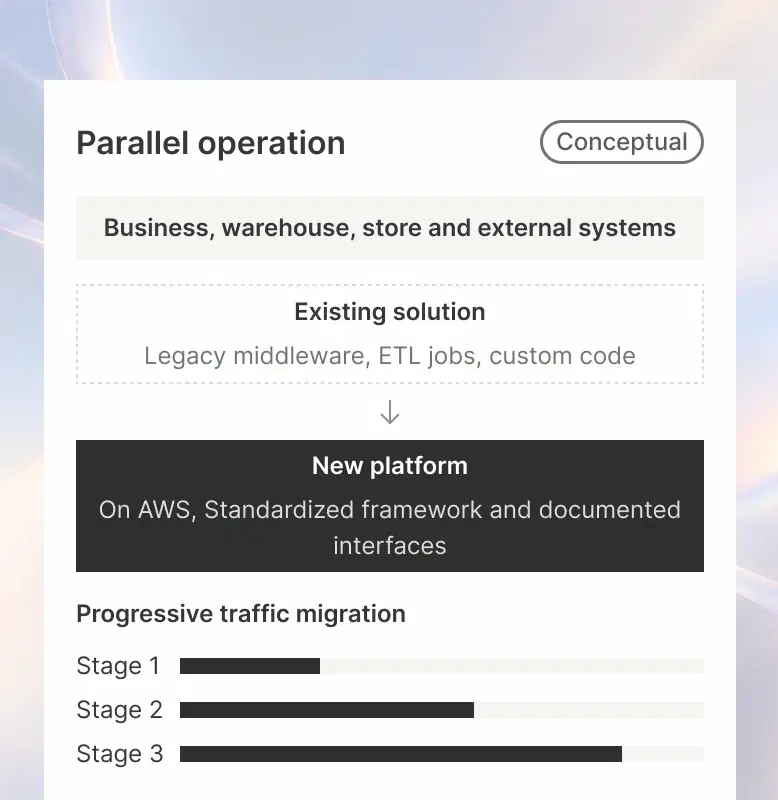
Parallel operation and progressive traffic migrationFigure 2. Conceptual view of the transition period. 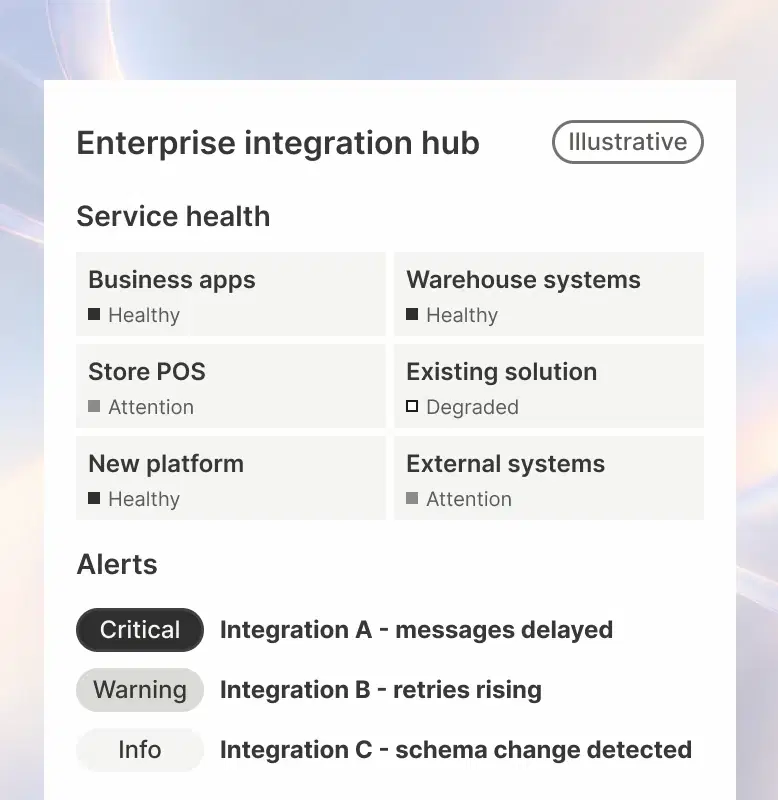
Enterprise Integration HubFigure 3. Illustrative interface. States, alerts and labels are placeholders, not production data.
Delivery method
Knowledge recovery, agent implementation and controlled migration.
We delivered the migration in six stages. AI supported knowledge reconstruction, planning, implementation and monitoring. Engineers validated findings and owned architecture decisions, acceptance and production releases.
01AI · Engineers
Recover system knowledge
Analysed repositories and available system information with AI; reconstructed integration behaviour, dependencies and documentation. Engineers validated the findings.
Claude via Amazon Bedrock
02Engineers
Define the target and migration plan
Used the recovered knowledge to establish a shared architecture, standard patterns and a sequenced implementation plan.
Recovered documentation and dependency maps
03Agents
Implement with engineering agents
Transformed and refactored in-scope services with AWS Transform and agent-assisted engineering, aligned with reusable templates and the approved architecture.
AWS Transform · Claude via Amazon Bedrock
04Engineers · CI/CD
Validate the implementation
Engineer review, behavioural checks and regression tests in CI/CD before release.
Test drafting with Claude via Amazon Bedrock
05Platform
Run platforms in parallel
Deployed the new platform alongside the existing solution so that migration could proceed progressively.
New platform hosted on AWS
06Monitoring · Engineers
Migrate traffic progressively
Transferred live traffic in stages, with centralised monitoring and AI-assisted operational analysis supporting engineering oversight.
Centralised monitoring · AI-assisted analysis
Figure 4. Delivered migration method. Engineer approval preceded every production release.
Technology used
- AWS Transform
- AI-assisted code transformation and modernisation of in-scope legacy services.
- Amazon Bedrock
- Managed access to the foundation models used in the engineering workflow.
- Anthropic Claude models on Amazon Bedrock
- Supported code analysis, knowledge reconstruction, documentation, refactoring and test drafting within the engineering workflow.
- AWS
- The target cloud environment for the migrated integration workloads.
AI-assisted operational monitoring was delivered as a separate capability alongside centralised observability. AWS Transform and Amazon Bedrock supported engineering work and did not sit in the runtime path of retail transactions.
Solution
Five connected deliverables.
We delivered the programme as one engineering system: reconstructed knowledge and a modernisation plan, a standardised framework, agent-assisted implementation, release and traffic-migration controls, and centralised monitoring with AI-assisted analysis.
01
Reconstructed system knowledge and modernisation plan
We delivered reconstructed documentation, a shared architecture and dependency mapping of the integration landscape, and a structured modernisation plan built from them.
02
Standardised integration framework
We delivered one framework with reusable templates, version-controlled code and consistent implementation patterns for the integrations.
03
Agent-assisted implementation workflow
We delivered a modernisation workflow in which AWS Transform and engineering agents implemented changes, with Claude via Amazon Bedrock supporting analysis, refactoring, documentation and test drafting.
04
Quality, release and traffic-migration controls
We delivered engineer review, regression testing in CI/CD, controlled releases and the parallel operation of the legacy and new platforms that allowed live traffic to move in stages.
05
Centralised monitoring with AI-assisted analysis
We delivered one monitoring hub covering service health, integration failures, alerts and dependencies, with AI-assisted analysis of operational behaviour during migration.
Before: Lost system knowledge
Documentation had fallen behind six years of change, and behaviour depended on specialist knowledge.
After: Reconstructed documentation
AI-assisted analysis, validated by engineers, rebuilt documentation of interfaces and dependencies.
Before: Scattered implementation patterns
Integrations used multiple languages, tools and practices across 20+ repositories.
After: Standardised framework
One framework with reusable templates set a consistent implementation pattern.
Before: Manual investigation
Changes required manual analysis of legacy code before implementation could begin.
After: Agent-assisted engineering
Engineering agents implemented changes, with engineer review and regression tests before release.
Before: Hard-to-observe changes
Fragmented monitoring made the effect of legacy changes hard to see.
After: Parallel run, shared visibility
Both platforms ran under centralised monitoring while live traffic moved progressively.
Results
Restored understanding and a repeatable way to engineer the landscape.
Delivered results

80%
Agreed legacy integration codebase migrated
1
Standardised integration framework
1
Centralised monitoring hub
6 mo
Programme duration
Landscape assessed · Reviewed during discovery
20+ repositories
Including external systems
140+ integrations
Connected to the integrations
~40 databases
Of accumulated change
~6 years
- System knowledge reconstructed and documented.
- A structured modernisation plan implemented with engineering agents.
- Parallel operation and progressive production-traffic migration, supported by AI-assisted monitoring.
Scope: the agreed custom integration codebase. Excludes vendor-owned ERP, WMS and POS products, third-party libraries and generated dependencies. Deployment: Migrated integration workloads were deployed on AWS.