Bringing structure to AI adoption in PropTech
From fragmented AI experimentation to a shared operating model: a three-month programme spanning company-wide assessment, strategy, harmonized governance, an AI-native product lifecycle and practical team enablement.
- AI Transformation
- AI Strategy
- Shadow AI Assessment
- AI Governance
- Compliance Harmonization
- Operating Model & PDLC
- AI Enablement
Client: Government and commercial ventures


Project description
Company-wide transformation in a highly governed environment.
SiriusOne supported a 350-person Middle Eastern organization in the real estate and PropTech sector, serving government and commercial ventures, through a three-month AI transformation programme. The engagement covered business, operational and technical functions across 16 teams and departments. Government-client information, personal data and strict security expectations made governance central to connecting AI opportunities with accountable decisions.
- Industry:
- Real estate & PropTech
- Solutions:
- Organization-wide AI transformation
- Clients:
- Government & commercial ventures
Governance & compliance context
- ISO/IEC 27001
- Information security
- ISO/IEC 42001
- AI management reference
- UAE PDPL
- Personal data, where applicable
- Government-client controls
- Security reviews & approvals
Reference requirements reviewed and harmonized into AI-use rules, applied according to the relevant activity, data category, tool and client.
Challenge
What the company needed to solve.
- 01 / DirectionFragmented initiatives: AI ideas needed a shared process for evaluation, prioritization and ownership across departments.
- 02 / ControlShadow AI exposure: AI use outside corporate oversight raised data-handling concerns, with added sensitivity around government-client information.
- 03 / RequirementsUnconnected requirements: Existing policies, compliance requirements, client obligations and security expectations had not been translated into consistent rules for AI use.
- 04 / CapabilityInconsistent practices: Business, operational and technical teams needed practical skills and clear processes to apply AI consistently in product delivery and everyday work.
The programme in practice
From understanding the business to changing how teams work.
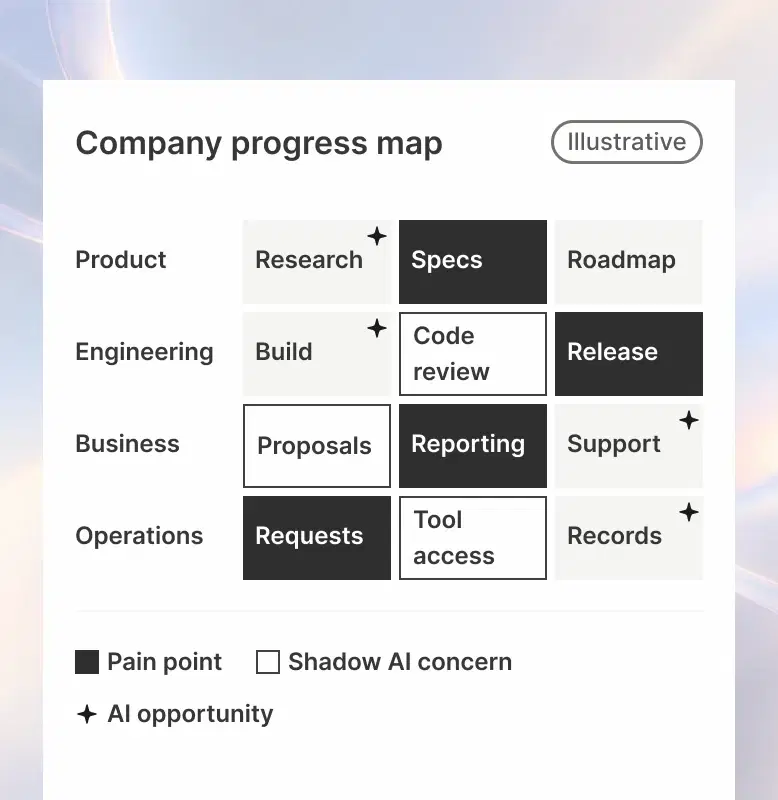
Assessment & strategyA 360-degree view of company processes connected operational pain points, Shadow AI concerns and AI opportunities to the adoption strategy. 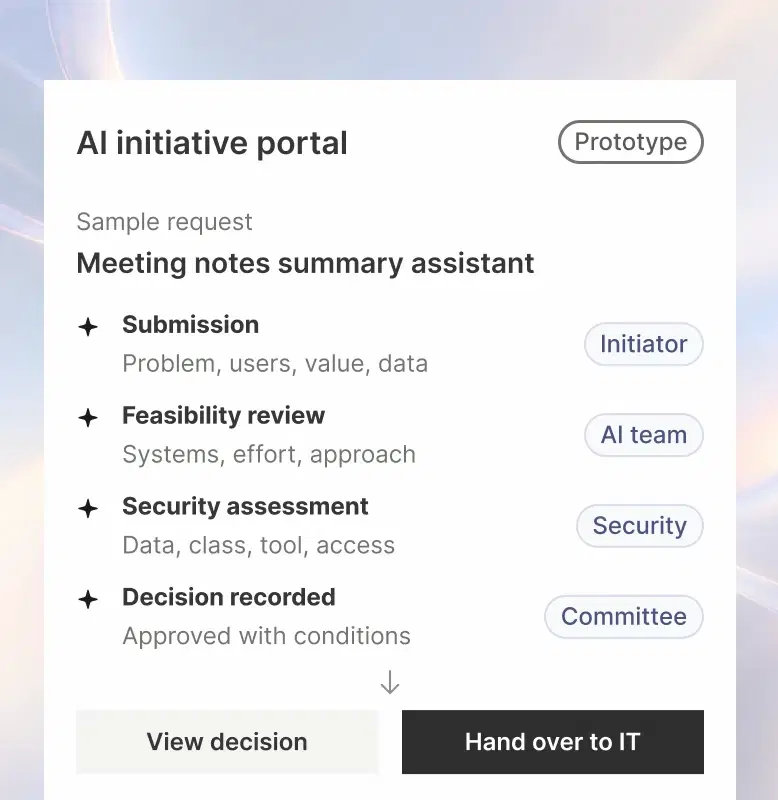
Governance & intakeHarmonized policies, committee responsibilities and an intake portal prototype connected feasibility, data and tool assessment, recorded decisions and IT handover. 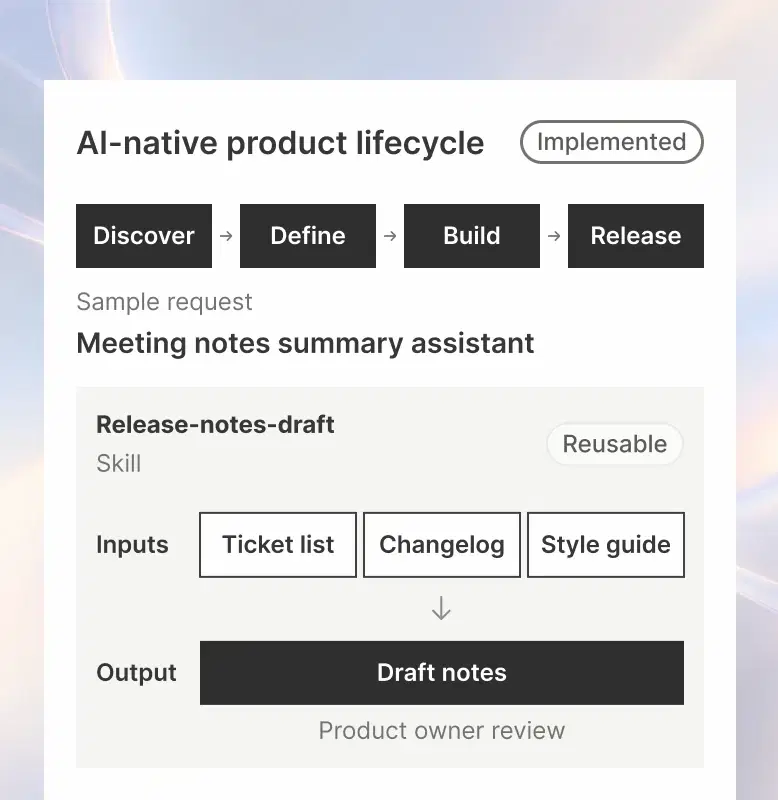
AI in practical deliveryThe AI-native PDLC and reusable skills linked shared context and human review to repeatable tasks, from product work to everyday operations.
Solution
One connected programme.
The programme ran for three months. We began by understanding the whole company, then connected the findings to an AI adoption strategy, harmonized governance, a shared intake process and an AI-native product lifecycle. These were implemented through practical work with teams using Claude, reusable skills and automations.
01Understand
360-degree assessment
Mapped company processes, workflows, bottlenecks, Shadow AI use and opportunities for AI.
02Prioritize
AI adoption strategy
Connected business needs to priorities and defined a transition towards managed AI use.
03Govern
Data & AI governance
Harmonized requirements into policies, data classification, a tooling strategy, tool assessment criteria and committee responsibilities.
04Decide
Initiative intake & portals
Defined submission, feasibility review, Security assessment, decisions and handover to IT, supported by internal portals.
05Deliver
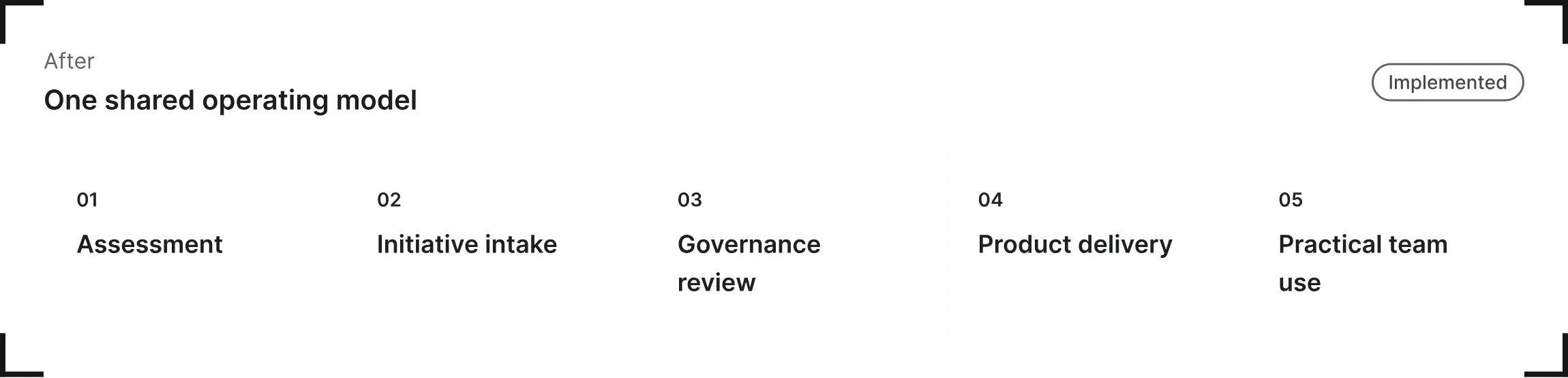
Operating model & AI-native PDLC
Implemented shared context, clearer handoffs and human review from discovery to release.
What we delivered over three months
Three consecutive phases · approximately 12 weeks
Weeks 1–2
Discovery & assessment
We conducted an intensive 360-degree discovery and assessment of the company’s processes, workflows, bottlenecks, AI usage, Shadow AI, tools, risks and opportunities.
Weeks 3–6
Strategy & harmonization
We developed the AI adoption strategy, harmonized requirements and aligned them with stakeholders, then delivered the governance policies, committee responsibilities, portals, data and tooling strategy, and shared processes.
Weeks 7–12
Implementation & enablement
We implemented and embedded the operating model and PDLC through practical work with teams, delivering workshops, reusable skills and automations.
Practical enablement across all workstreams
- Business, operational & technical teams
- Claude
- Reusable skills
- Task-specific automations
Governance & operating model
From separate requirements to shared rules and ways of working.
Harmonizing requirements
Requirements from several sources were brought together and translated into rules that teams across the organization could apply.
Review
Reviewed existing policies, relevant compliance requirements, client obligations and security expectations, with ISO/IEC 27001, ISO/IEC 42001, UAE PDPL and government-client controls as reference points.
Map
Identified how each requirement applied to different activities, data categories and tools.
Align
Aligned the requirements and their interpretation with the relevant stakeholders.
Translate
Translated them into consistent AI-use rules, data-handling guidance across four data classes, tool assessment criteria and decision processes.
Connect
Connected the rules to committee responsibilities, initiative intake and the supporting portals.
Implementing the operating model & PDLC
The operating model and AI-native PDLC were implemented and embedded through practical work with teams during the final six weeks.
Roles
Defined who submits, assesses, approves and implements AI initiatives, including the responsibilities of the governance committee.
Routes
Set initiative submission, feasibility review, Security assessment and decision routes, with recorded decisions and handover to IT.
Handoffs
Defined handoffs between business teams, AI, Product, Engineering, Security and IT.
Context
Introduced shared context and human review points across the lifecycle, from discovery to release.
Practice
Applied the model with teams on their own tasks through workshops, reusable skills and automations.
Results
From fragmented to governed.
Before: Limited visibility
No shared view of how processes, AI usage, Shadow AI, tools and risks related across the company.
Established through the programme: A shared assessment
A 360-degree assessment of processes, risks and AI opportunities across 16 teams and departments.
Before: Fragmented initiatives
AI ideas developed in separate teams without coordinated priorities.
Established through the programme: A coordinated AI adoption strategy
Priorities connected to business needs, with a defined transition to managed AI use.
Before: Unconnected requirements
Policies, compliance requirements, client obligations and security expectations had not been translated into rules for AI use.
Established through the programme: Harmonized governance, data and tooling rules
Consistent AI-use rules, four data classes, data-handling guidance and tool assessment criteria.
Before: Unclear governance ownership
Teams needed clarity on who assesses tools, authorizes use and implements access controls.
Established through the programme: Defined responsibilities and decisions
Committee responsibilities and decision processes connecting AI assessment, Security review and IT implementation.
Before: Unrouted AI initiatives
Ideas lacked a consistent route for submission, assessment and ownership.
Established through the programme: Supporting portals and initiative intake
A documented intake route supported by internal portals, including an intake portal prototype.
Before: Separate ways of working
Business teams, Product, Engineering, Security and IT lacked shared context and clear handoffs.
Established through the programme: An implemented operating model and AI-native PDLC
Roles, handoffs, shared context and review points, applied through practical work with teams.
Before: Hard-to-repeat practices
Useful AI experiments were difficult to repeat or share between teams.
Established through the programme: Practical skills, reusable assets and automations
Developed with teams across 57 workshop sessions.
The programme in numbers
A shared foundation for AI-native ways of working.

3
Months of programme duration
350
Employees in the organization
16
Teams and departments covered
57
Workshop sessions delivered
Three consecutive phases
Weeks 1–2 · 3–6 · 7–12
Workshop cycle per team
Discovery to Practical application to Review
Reference requirements
ISO/IEC 27001 · ISO/IEC 42001 · UAE PDPL
Data-handling guidance
4 data classes
Teams and departments covered
- Strategy
- HR
- Finance
- QA
- Business
- Marketing
- Learning and Development
- UI/UX
- Backend
- DevOps
- Frontend
- Data
- GIS
- Operations
- Product
- AI
- IT
- Venture team
The 57 workshop sessions were delivered over approximately six weeks, with every team receiving at least three dedicated sessions. Each team’s workshop cycle followed three stages.
01
Discovery
Identified team-specific tasks, workflows and use cases where AI could help.
02
Practical application
Applied Claude, reusable skills and automations to those tasks in hands-on sessions.
03
Review
Reviewed the results with each team and provided implementation guidance and next steps.
Over three months, the components were developed as one programme: the assessment informed the strategy, harmonized requirements shaped the governance, data and tooling rules, committee responsibilities and intake routes turned those rules into decisions, and the operating model and AI-native PDLC carried them into the everyday work of teams.