SiriusOne:
From No-Code Platform to Scalable Web Cloud Infrastructure
Full-stack migration from a vibe-coding environment to a self-controlled cloud architecture — enabling secure hosting, backend ownership, CI/CD automation, and long-term scalability.Client & Project Overview
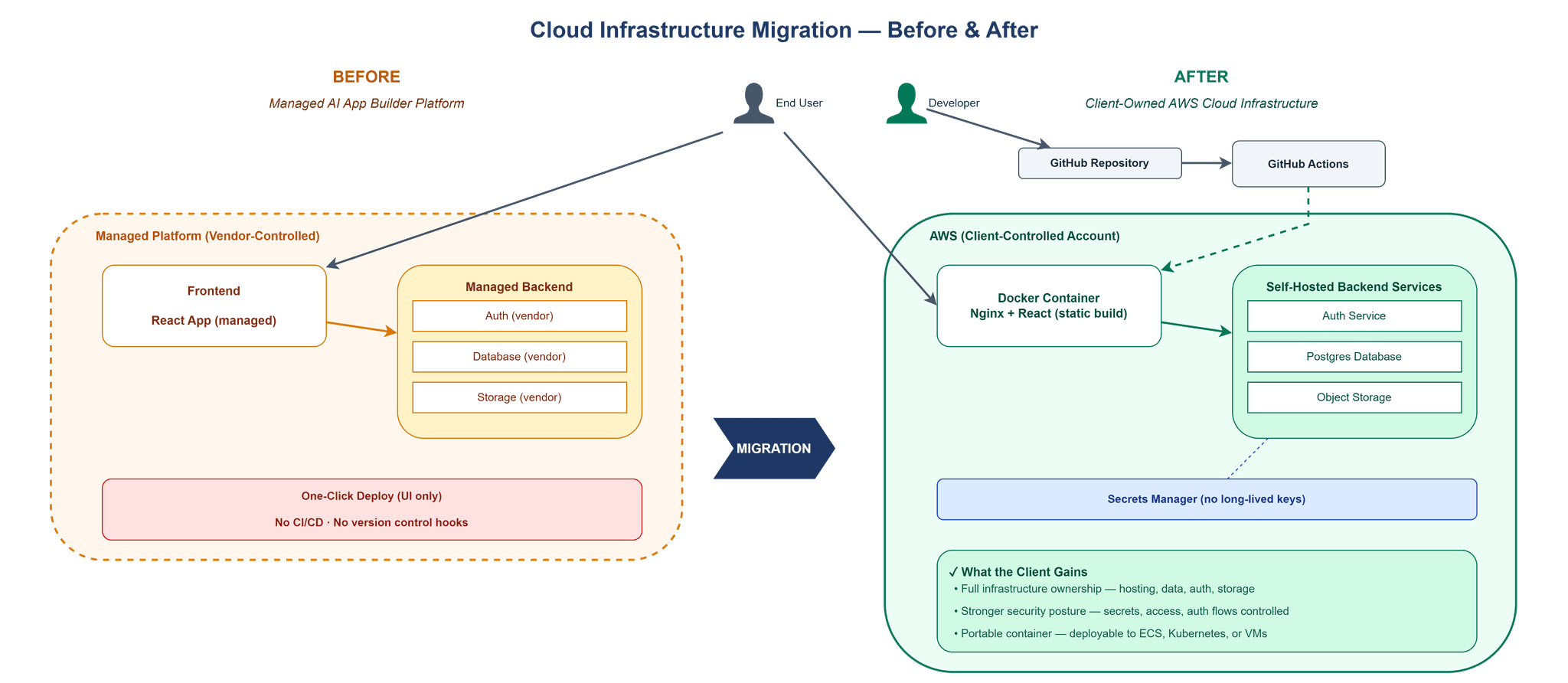
A growing product team needed to move beyond the limitations of a managed application platform as infrastructure control, compliance, and scalability became business-critical. The goal was to preserve frontend development speed while gaining full ownership of production hosting, backend services, and deployment processes.
The client had built their initial product using a vibe-coding platform — a common and effective starting point for teams moving fast in the early stage. Tools like Lovable, Bolt.new, Replit, v0, and Base44 are excellent for rapid MVP validation: they generate working React applications quickly, abstract away backend provisioning, and let small teams ship without a full engineering org. Workflow automation platforms like Make.com and Bubble extend this further — connecting services and building logic without writing code.
But these platforms share a structural ceiling at production scale. Even when source code is accessible, teams still inherit opinionated backend choices, hosting dependencies, and deployment flows that weren't designed for compliance reviews, custom CI/CD, or long-term operational ownership.
SiriusOne designed and implemented a controlled migration strategy that transferred the application to client-managed cloud infrastructure with minimal disruption to ongoing product delivery.
Business Problem
The original setup supported fast product launch, but it introduced structural constraints once the product matured. Limited backend ownership, external dependency on managed hosting, and restricted control over authentication, storage, and deployment flows created operational risk.
Even on platforms that expose source code — like Replit or Bolt.new — production-grade DevOps requires dedicated engineering effort that most product teams aren't resourced to handle alone. Secrets management, OIDC-based CI/CD, containerized deployments, and reproducible environments sit outside what vibe-coding tools were built to deliver.
The client needed a production-ready environment that improved security, supported scaling, and gave the team direct control over infrastructure, data, and release management — without rebuilding the product from scratch.
Tech Stack
Cloud: AWS
Frontend: React · Vite
Backend: Self-hosted Postgres + auth & storage services (Supabase-compatible migration path)
DevOps: GitHub Actions · Docker · Nginx
Deployment: Container-based CI/CD
Security: OIDC authentication · secrets management
#CloudMigration
#AWS
#DevOps
#VibeCoding
#NoCode
Project Timeline

Duration
3–5 weeks
Effort
~150 hours (part-time engagement across specialists)
Discovery & Architecture
~0.5 week
Architecture review, dependency mapping, migration plan, target stack and hosting model selection
Development
2–3 weeks
Backend migration, schema recreation, frontend containerization, CI/CD setup, environment configuration
Testing & Security Review
~0.5 week
Auth validation, route handling, storage checks, access review, rollout readiness
Deployment & Handover
~0.5 week
Production launch, documentation, team enablement, operational handover
Team involved

DevOps Engineer (Lead)
Owned target architecture, containerization, and CI/CD automation.

Backend Engineer
Migrated schema, auth configuration, storage, and backend services.

Frontend Engineer (part-time)
Prepared static build deployment and SPA route behavior.

Project Manager (part-time)
Coordinated milestones, rollout, and cross-team validation.
Solution Overview
Frontend Hosting Migration
The frontend was restructured for deployment outside the managed platform using static builds and cloud-ready hosting patterns.
Containerized Deployment Model
A multi-stage Docker build with Nginx delivery created a consistent artifact deployable to Kubernetes, ECS, VMs, or internal platforms.
Backend Ownership Transfer
Database schema, authentication, storage, and backend services were migrated to a self-controlled environment — eliminating third-party backend dependencies inherited from the original no-code stack.
Secure CI/CD Automation
GitHub Actions with OIDC-based authentication enabled secure, repeatable deployments without long-lived secrets in the pipeline.
Flexible Infrastructure Path
The solution supports multiple maturity levels — from managed hosting to full self-hosted backend and infrastructure control — giving the team a clear path to scale without re-platforming again.
Results
Full Infrastructure Ownership
Production hosting, backend services, authentication, storage, and deployment workflows moved into a client-controlled environment.
Repeatable Production Deployment
The application was restructured for stable CI/CD delivery through containers and cloud-native release patterns.
Stronger Security Posture
Secrets, auth flows, redirect handling, and deployment access controls were aligned with mature operational requirements.
Preserved Product Velocity
The migration allowed the team to retain its familiar development flow while gaining long-term infrastructure independence.

Similar
implemented cases:
From No-Code Platform to Scalable Web Cloud Infrastructure
Cloud-Native Middleware Platform for Logistics


Cold Chain Management Optimization with AWS & IoT


Serverless Data Processing for Financial Services


Cloud-Native CI/CD Pipeline for Enterprise Applications


Scalable Cloud-Native Data Lake for Enterprise-Wide Analytics